.png)

Is Your Data Ready for AI?
The most common reason companies postpone AI is a sentence we hear almost weekly: our data is not ready.
It is said with complete conviction, usually by someone picturing a heroic two-year data warehouse project that has to happen first. Clean everything, unify everything, then, someday, AI.
That plan is mostly wrong, in both directions. Companies overestimate what the first AI project needs, and underestimate what the tenth one will.
Let us take those one at a time.
The first AI project does not need your company's data. It needs one process's data. If you want to automate invoice intake, you need the invoices, the orders they match against, and the rules for booking them. Nothing else. The state of your marketing data is irrelevant.
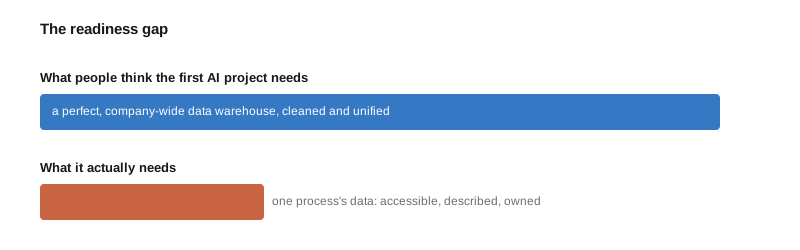
The gap between the imagined requirement and the real one is roughly a two-year project.
And for that one process, readiness means three specific things. None of them is a warehouse.
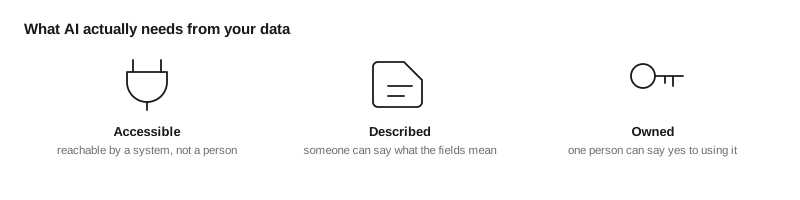
Accessible means a system can reach the data without a human copying it somewhere first. An export, an API, a shared folder with structure. If the invoices live in a mailbox only Franziska can open, they are not accessible, however tidy they are.
Described means someone can say what the fields mean and which values are trustworthy. Not documentation for its own sake: one page that says amount_2 is the corrected total and the old status field lies. Every company has these secrets. AI cannot guess them.
Owned means one person can say yes. Yes, you may use this data for this purpose; yes, this is the system of record. If that yes requires four meetings, the problem is not data readiness. It is decision readiness, and no pipeline fixes it.
That is the whole list. Accessible, described, owned, for one process. Most companies can get there in weeks, not years.
Now the other direction, where the optimists go wrong.
What works for one process does not scale to ten by itself. Every project you add wants access, definitions and permissions, and if each one wires its own, you build a new kind of spaghetti: AI spaghetti, with better marketing.
So the sequencing that works: do not build the warehouse first, and do not skip the foundations forever. Start with one process, and build its wiring as if others will follow, because they will. Shared access patterns, definitions written down where the next project can find them, permissions granted to roles instead of individuals.
The first project then does double duty. It returns value on its own, and it becomes the standard the next projects copy.
A note on quality, because it carries the most anxiety. AI is surprisingly tolerant of imperfect data and completely intolerant of undescribed data. Typos, gaps and inconsistent formats are normal. A field whose meaning nobody knows is poison. Spend your effort on description, not cosmetic cleaning.
And a note on the two-year warehouse: sometimes it is the right project, for reporting, for compliance, for scale. But it is a different project with a different justification. Do not put it in front of your first AI use case like a toll booth.
So, is your data ready for AI? The question is too big. Pick the process. Ask whether its data is accessible, described and owned. If yes, you are ready this quarter. If not, you now have a list that fits on one page, and a few weeks of plain work that pays for itself either way.
Frequently asked questions
What data do you need to start with AI?
The data of one process, not the whole company. For invoice automation: the invoices, the orders, and the booking rules. That data needs three properties: accessible to a system, described so a human can explain the fields, and owned so one person can approve its use. Everything else can wait.
Do we need a data warehouse before starting with AI?
No. A warehouse is sometimes the right project for reporting or scale, but it is not a prerequisite for a first AI use case. Putting a two-year data project in front of a six-week automation is the most expensive way to postpone learning what AI can do for you.
How clean does data have to be for AI?
Less clean than most people assume. Modern AI handles typos, gaps and inconsistent formats well. What it cannot handle is undescribed data: fields whose meaning nobody can state, or values that silently lie. Invest in one page of honest field descriptions before any cosmetic cleanup.
How long does it take to make data ready for a first AI project?
For a single process, typically weeks: set up access, write down what the fields mean, and get one owner to approve the use. If it is taking months, the blocker is usually decision-making or permissions, not technology, and that is worth knowing early.
How do we avoid chaos when AI projects multiply?
Build the first project's wiring as if others will follow: shared access patterns, definitions stored where the next team can find them, and permissions granted to roles rather than individuals. The first use case then becomes the template, and each following project gets cheaper instead of messier.