.png)

How to Measure the ROI of AI, Honestly
The most common question in our AI readiness checks is also the one with the most dishonest answers in circulation: what is the return?
You have seen the numbers. Forty percent productivity gains. Hours saved per employee per week. Most of them come from surveys where people estimate their own time savings, usually in the honeymoon week of a new tool.
We run AI projects for a living, so we would love those numbers to be true. Here is what we can actually defend.
First, the shape of the return is wrong in most plans. Teams get slower before they get faster.
The first weeks of a serious AI rollout are a tax: training, process change, people double-checking the machine because they do not trust it yet. That is not failure. That is the J-curve, and if you do not budget for it, you will cancel exactly the projects that were about to work.
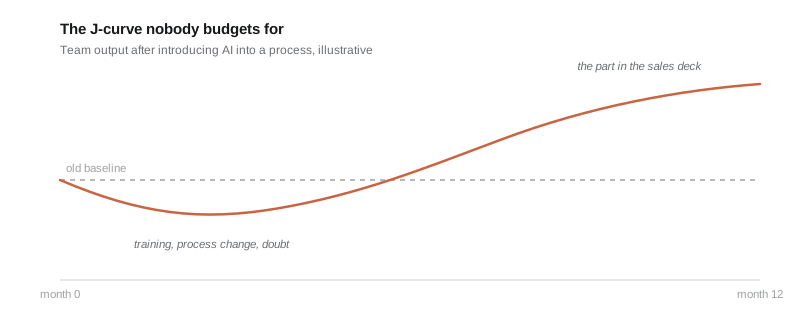
Budget for the dip, or you will cancel the project at its lowest point.
Second, most measurements stop at the shallowest layer.
We think about AI return in three layers, and the difference between them is the difference between a nice slide and a real number.
Layer one is time saved. Easy to measure, easy to fake. Ask people whether a tool saves them time and they will say yes, roughly forever. Saved minutes are real, but they evaporate into the workday unless something else absorbs them.
Layer two is quality and speed. Error rates, cycle times, response times, rework. These are measurable without asking anyone how they feel, which is exactly why we trust them.
Layer three is redeployed capacity. What did you do with the freed hours? Faster quotes, more client contact, an extra project per quarter, one contractor not renewed. This is the only layer a P&L ever notices.
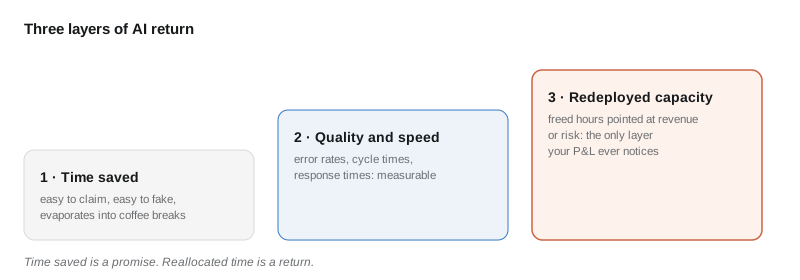
Each layer is harder to fake than the one before it.
Time saved is a promise. Reallocated time is a return.
So how do you measure honestly? Three rules we hold ourselves to in client projects.
Baseline before you start. If you do not know how long invoice processing took before, you will never know what changed. Two weeks of boring measurement beats a year of arguing about whether the project worked.
Measure the process, not the model. No P&L contains an accuracy percentage. Count outcomes: filings completed, tickets closed, days from enquiry to quote.
Decide in advance what happens to the freed time. That decision, not the model, is where the return is actually made. Nobody makes it for you, and no vendor will bring it up.
What do we actually see in projects? Honest ranges, not case-study theatre.
Narrow, supervised automation of a document-heavy process typically pays for itself within the first year, sometimes within a quarter. Broad rollouts of general AI tools for everyone mostly produce layer-one numbers and little else.
The first project also carries a hidden asset: the wiring. Data access, permissions, review workflows. The second project reuses all of it, which is why AI returns compound and why the first number always looks the worst.
When should you not expect a return? When the process is undefined, when nobody owns the outcome, and when the plan says transform instead of naming a workflow.
The summary nobody puts on a conference slide: AI ROI is real, but it is earned in the boring places. Baselines, review steps, and a decision about what the freed hours are for.
If a vendor promises you a return without asking what you will do with the saved time, they are measuring layer one and selling layer three.
Measure honestly and the number will be smaller than the slide said, and real. We will take that trade every time.
Frequently asked questions
How do you measure the ROI of an AI project?
Baseline the process before you start, then count process outcomes, not model metrics: cycle times, error rates, completed work per week. Finally, track what the freed capacity was redeployed to. Return lives in outcomes and reallocated hours, never in usage statistics or self-reported time savings.
Why do most AI ROI numbers mislead?
Three reasons: they rely on people estimating their own time savings, they measure during the honeymoon period of a new tool, and they skip the baseline, so there is nothing to compare against. Saved minutes that nobody redeploys also produce no financial return, yet they get reported as one.
How long until an AI project pays off?
Expect a J-curve: output dips for the first weeks while people train and processes change. Narrow, supervised automation of a document-heavy process typically pays for itself within the first year, often faster. Broad tool rollouts without process change frequently never do.
What should we measure before starting an AI project?
Pick one process and spend two weeks measuring it as it is: how long it takes, how often it goes wrong, what it costs, who touches it. That baseline is the cheapest part of the whole project and the only thing that makes the later ROI conversation honest.
Does AI ROI show up in the profit and loss statement?
Only through redeployed capacity: revenue from faster quotes and extra client work, or costs that genuinely go away. Time savings alone never reach the P&L. The deliberate decision about what to do with freed hours is what converts a productivity story into a financial one.