.png)

AI Agents in Production: What Survives?
We have sat through a lot of AI agent demos in the last two years. They are starting to blur into one.
Someone types a request. The agent plans, calls a few tools, and hands back a finished piece of work. The room nods along, somebody says "transformative", and for about four minutes it really does feel like the future.
That question is what production means. It is where an agent either becomes useful or becomes a story you tell at conferences.
Here is the sort of thing a demo will never show you, all of it taken from projects we have actually shipped.
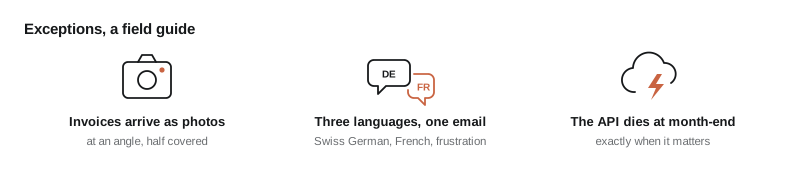
An invoice arrives as a photo taken at an angle, with a thumb over half the total. A client answers a precise question in Swiss German, French and open frustration, in the same email. The accounting API goes down on the last day of the month, which is naturally the only day it truly matters.
None of this is exotic. It is just what business looks like up close. Demos run on the happy path; real companies run on exceptions.
Most of our agent work happens in finance, Treuhand and other regulated corners of the Swiss economy, where "the AI made it up" is not a funny story for the team chat but a liability with a paper trail. Do enough of these projects and your taste changes: you stop being impressed by clever and start being impressed by supervised.
The agents that survive production have never been the smartest ones we built. They are the ones someone can check.
The mental model we give clients: you are not installing software, you are hiring. Specifically, you are hiring a very fast, absurdly well-read junior employee who has no common sense yet and, unless you build one, no memory of yesterday.
Nobody hands a new hire the company credit card in week one. So the agent starts with narrow permissions.
"I just did it" is not an acceptable answer from a junior, and it is not acceptable from an agent either. Every step it takes lands in a log a human can read six months later.
And no trainee sends client letters unreviewed in their first month. So the agent drafts, a person approves, and autonomy grows one task at a time, at the speed the error rate allows.
Written out like this it sounds obvious. It is. It is also precisely the part that was skipped in every failed pilot we have been called in to rescue.
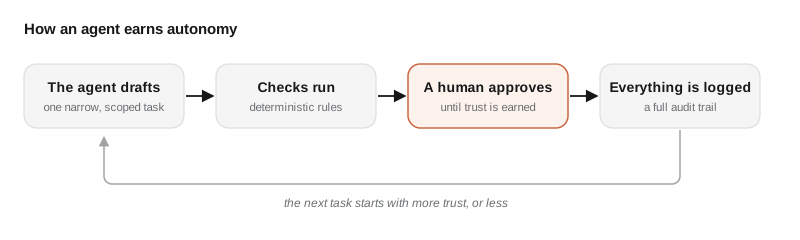
Autonomy is earned one supervised task at a time.
Which brings up the least popular thing we tell prospects: most of the work is not AI work.
The model is maybe a fifth of the system. The rest is retries, queues, permissions, monitoring, review workflows, and the integration with an ERP that has been running since 2014 and communicates exclusively in CSV. Nobody puts that part on a slide. It decides everything.
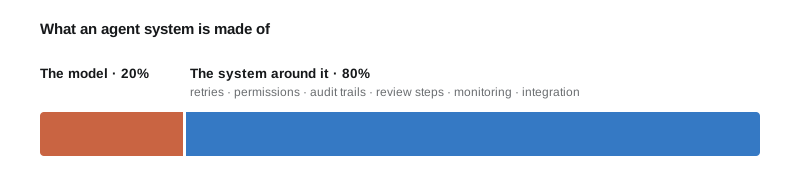
The model is the small part. The system around it decides whether the agent survives.
It is also why "we tried an agent and it didn't work" almost always unpacks to "we tried a model without a system around it". The model was probably fine.
The other thing that kills agent projects is scope, and it does its damage early, usually in the kickoff meeting.
An agent that runs one process end to end, say invoice intake: read it, check it against the order, book it, flag the strange ones, earns its keep every working day. You can measure it, argue with it, improve it.
An agent that "helps with everything" cannot be measured at all, so nobody notices when it is wrong. Eventually a customer does.
Narrow feels timid when you are writing the project brief. It is not timid. Narrow is what makes trust possible.
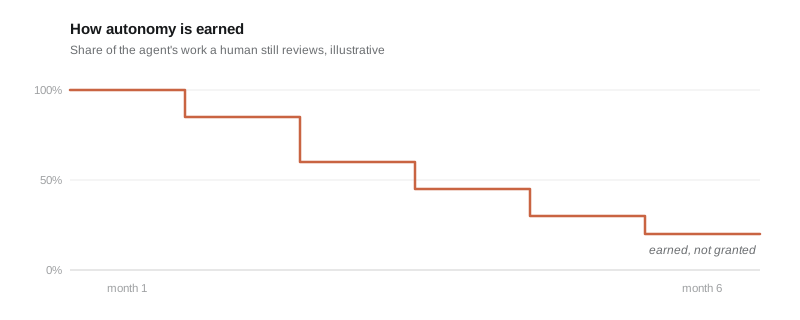
The pattern from our own projects: review everything at first, then let the error rate argue for autonomy.
One more thing we underestimated ourselves in the early projects: nothing stays still. Models get updated. Processes drift. The client who always paid late gets acquired by one who pays never.
An agent in production is less like a finished project and more like a colleague you keep managing. This is why we stopped selling go-lives and started staying for the maintenance. That is where the compounding happens, and also where the rot starts if nobody is looking.
So, are AI agents ready for production?
A lot of them already are. They book invoices, triage inboxes and prepare filings inside companies that will never write a blog post about it, which is roughly how you can tell it is real.
The better question points the other way: is your process ready for an agent? Defined enough to hand over, measured enough to supervise, honest enough about where its exceptions actually live.
The technology stopped being the bottleneck somewhere in the last two years. What is left is clarity, and that has always been the harder part.
Frequently asked questions
What is an AI agent, practically speaking?
A software system where a language model does not just answer questions but does work: it reads context, decides on next steps, calls tools such as your inbox, your ERP or your document system, and produces an outcome. The difference between a chatbot and an agent is the difference between asking someone for directions and having them drive.
Why do most AI agent pilots never reach production?
Because pilots optimise for the demo. They handle the happy path, skip exception handling, keep no audit trail and have no owner. Production requires permissions, human review steps, monitoring and someone responsible when the agent is wrong. Most failed pilots are organisational failures, not technical ones: the model worked, the system around it was never built.
How do you make AI agents safe for regulated industries?
Four things, none optional: narrowly scoped permissions so the agent can only touch what it needs; a complete audit trail of every step, decision and source; human approval on anything that leaves the company, at least until trust is earned per task; and deterministic checks around the model for anything involving money, deadlines or law. The model proposes. The system disposes.
How narrow should a first agent be?
One process, end to end, with an output you can measure. Invoice intake. Email triage. Meeting follow-ups. If you cannot describe what "correct" looks like for the task, the task is too broad for a first agent, and probably too vaguely defined for a human as well.
What does it cost to run an AI agent in production?
Less than the employee it assists, more than a software subscription. The model usage itself is rarely the significant cost. Integration with your systems, the review workflows and ongoing maintenance are. Budget for an agent the way you budget for any system that touches your operations: a build phase, then continuous care, not a one-off purchase.