.png)

Why AI Pilots Never Reach Production
A while ago I sat in a demo where an AI system read incoming supplier invoices, matched them against orders, and flagged the mismatches. It worked. The room was impressed, the budget was approved, and everyone left with the feeling that the future had arrived on schedule.
I checked in on that project this spring. It is still a pilot. It has been a pilot for over a year. Nobody killed it, nobody shipped it, and the invoices are still matched by hand.
This is the most common failure mode in business AI right now. Not models that fail. Pilots that work and still never reach production. Ask around in your own network and you will hear the same story with different logos.
The explanation is rarely technical. The demo and the production system live in two different worlds, and most pilots are built for the wrong one.
A demo runs on twenty hand-picked documents. Production runs on whatever arrives, including the invoice scanned upside down and the one where the supplier wrote the total into the comments field.
A demo has a patient operator who knows exactly what to click. Production has a busy clerk with a queue, a deadline, and no appetite for babysitting new software. In a demo, nobody counts the errors. In production, every error has a cost, and someone is paid to notice.
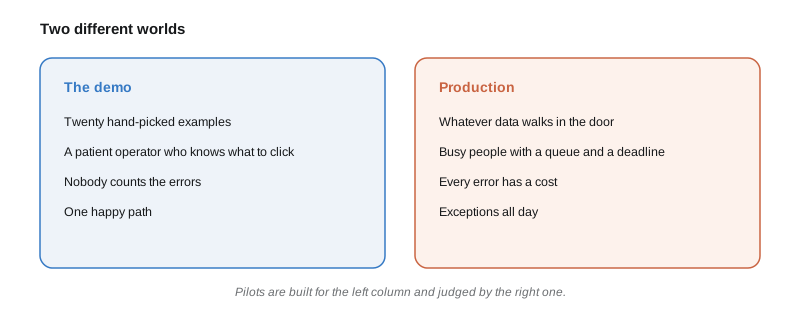
The pilot is built for the left column. The business judges it by the right one.
So the demo impresses, and then the questions start. Who owns this? Who fixes it when it breaks at month end? Where do the wrong answers go? Nobody planned for those questions, because the goal was a good demo, and a good demo does not need answers.
Vendors make this worse, and I say that as one. A pilot is the easiest thing in the world to sell. It is cheap, it is low risk, and nobody has to change how they work yet. Production is where the change management lives, and change management does not fit in a demo. So the market produces pilots the way a bakery produces rolls.
From what I see in mid-sized companies, the funnel looks roughly like this. Ten pilots get started. Seven produce a demo people like. Three have a named owner who wants the result inside their own process. One is in production a year later.
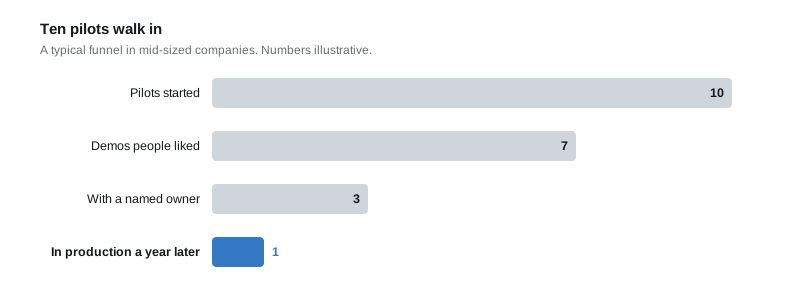
The funnel narrows at ownership, not at technology.
That narrowing point matters. A pilot without a person who wants to run the result in their own department is a science project with a deadline extension. The technology was never the bottleneck. The commitment was.
Over the years we changed five things about how we run pilots, and the odds changed with them.
First, pick a process that already has an owner, and make that owner the customer of the pilot. Not the innovation team, not IT, not a steering committee. The person whose Monday gets better if this works. If no such person exists, do not start.
Second, agree on kill criteria before you begin. For example: if accuracy on real data stays below 95 percent after six weeks, or if handling an exception takes longer than doing the task by hand, we stop and write down what we learned. A pilot that cannot fail is not an experiment. It is theatre.
Third, wire in real data from the first week. Copies of real invoices, real emails, real records, with all their mess. Synthetic test data is how you build something impressive that has never met your company.
Fourth, measure against the current process, not against perfection. The clerk gets things wrong sometimes too. The question is never whether the system is flawless. It is whether the process with the system beats the process without it on cost, speed, or quality, exceptions included.
Fifth, build the exception path before you scale the happy path. Where does a rejected case go? Who looks at it, in which tool, within what time? Production readiness lives in that answer, and it is exactly the part demos skip.
And involve IT in week one, even if the pilot runs outside their stack. Not for permission. For reality. They know which systems the result must talk to and which rules the data has to follow. An IT department surprised in month four has every right to say no, and usually does.
None of this makes a pilot bigger or more expensive. Most of it makes it smaller. One process, one owner, real data, clear exit rules. That costs less than the sprawling proof of concept with three use cases and a steering committee, and it produces something you can actually ship.
The mental shift fits in one sentence. A pilot is not a demo of a future system, it is the smallest version of the production system you can safely run. Build the first and you get applause. Build the second and you get software.
A pilot that fails against honest criteria is a good outcome too. You spent a few weeks learning that the process or the data is not ready, for a fraction of what a failed rollout costs. The only truly bad outcome is the one from the invoice story. A pilot that neither ships nor dies, eating attention for a year.
Questions I hear about AI pilots
Why do most AI pilots fail to reach production?
Usually not for technical reasons. The common causes are missing ownership, no agreed success criteria, synthetic instead of real data, and no plan for exceptions. The pilot is built to impress in a demo, and nobody prepared the answers production asks for: who runs it, who fixes it, where the errors go.
How long should an AI pilot run?
Six to ten weeks on real data is enough for most process pilots. If a pilot cannot show a clear result in that window, the scope is too big or the data is not ready. Pilots that run for months usually have unclear success criteria rather than hard problems.
What are good kill criteria for an AI pilot?
Agree on them before you start. Useful ones: a minimum accuracy on real data, a maximum time per handled exception, and a comparison against the current manual process. If the pilot misses them at the deadline, stop, write down what you learned, and move on.
What makes an AI pilot production ready?
Treat it as the smallest production system rather than a demo: real data from week one, a named owner in the business, an exception path with a responsible person, and IT involved from the start. If those four exist, the step from pilot to production is small.