.png)

How to Choose an AI Partner (and When You Don't Need One)
An odd article for a consultancy to write, we know. Bear with us: we have watched enough companies choose badly that the honest version seems more useful than another brochure.
Start with the question nobody asks first: do you need a partner at all?
If your goal is to try AI tools, you do not. Give a curious team two months, a small budget and permission to experiment. Hiring consultants to introduce your staff to a chat assistant is paying restaurant prices for toast.
You need outside help when the work touches your systems and your risks: connecting AI to real data, automating a process where mistakes cost money, or making the whole thing survive past the first enthusiastic quarter.
If that is where you are, here is what we would look for, including the things that would make us walk away.
First, the red flags, because they are easier to spot than the virtues.
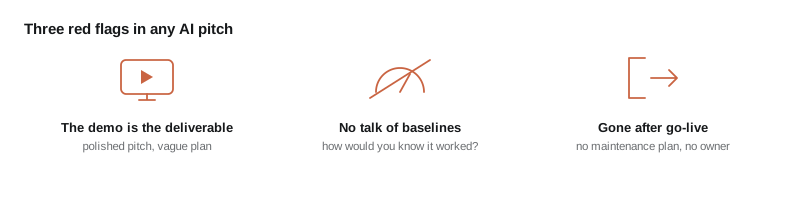
A partner whose pitch is mostly demo is selling you the easiest 20 percent of the project. Demos are cheap now. Ask what happens when the invoice arrives as a crooked photo, and watch whether the answer is specific or a slide transition.
A partner who never mentions baselines has no plan to prove anything. If they do not ask how long the process takes today, they cannot show you what changed. That is not an oversight. It is a business model.
And a partner with no maintenance story is planning to leave. AI systems drift: models update, processes change, edge cases accumulate. Ask who answers when something breaks eight months in, and what that costs.
The pattern behind all three is the same, and it shows up clearly if you plot where a vendor's attention goes over the life of a project.
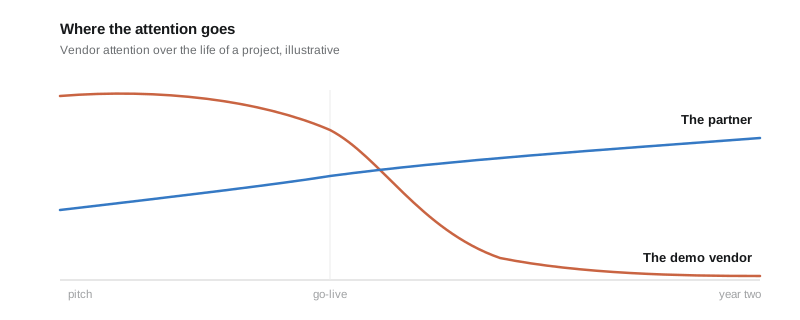
The pitch tells you little. The year after go-live tells you everything.
Now the positive signals, the ones we would weight heavily if we were buying.
They talk about your process more than their technology. The right partner asks what a bad week looks like in your operation before naming a single model.
They give you real numbers with real caveats. Anyone promising 40 percent productivity across the company is reading you a survey. Someone who says a range, and tells you what it depends on, has done the work before.
They tell you what not to do. A serious partner will point at half your wishlist and say: buy this part off the shelf, skip that part entirely. Advice that shrinks the invoice is the cheapest trust signal there is.
They put maintenance in the first proposal. Not as an upsell after go-live. In writing, with a price, from the start.
Their references talk about year two. Any vendor can produce a happy quote from launch week. Ask to speak to a client who has been running the system for a year.
Size matters less than people think. What matters is who actually does the work. Ask whether the people in the pitch are the people on the project. In large firms the answer is usually no, and everything downstream follows from that.
One more thing that is easy to check and telling: ask them to describe a project that failed and what they changed because of it. Everyone who has shipped real systems has this story. Anyone who does not is either new or careful with the truth, and neither is what you want near your operations.
Choosing well is mostly about refusing theatre. The companies that get AI to work rarely bought the most impressive demo. They bought the partner who asked the most uncomfortable questions in the first meeting.
Frequently asked questions
When does a company need an AI consultancy, and when not?
You do not need one to experiment with AI tools: a curious team, a small budget and two months do that better and cheaper. You need outside help when AI touches your systems and risks: real data connections, processes where errors cost money, and systems that must keep working long after the pilot excitement fades.
What are the biggest red flags when choosing an AI partner?
Three stand out: the pitch is mostly demo with no talk of exceptions; nobody mentions measuring a baseline, so success can never be proven; and there is no maintenance plan, meaning they intend to leave after go-live. All three predict the same outcome: an impressive start and an abandoned system.
What questions should we ask an AI vendor before signing?
Ask what happens with the messy cases, not the happy path. Ask how they will measure the current process before changing it. Ask who maintains the system in year two and what that costs. Ask whether the people pitching are the people delivering. And ask for a reference client who is one year past go-live.
Does the size of the AI consultancy matter?
Less than the delivery model does. What matters is whether the senior people in the pitch do the actual work, how fast decisions get made, and who owns the outcome. A small senior team that stays usually beats a large firm that rotates juniors through your project.
How much should AI consulting cost?
Expect discovery and a first production use case to price like serious engineering work, not like a workshop. Be suspicious at both ends: very cheap usually means a demo in disguise, and very expensive with vague deliverables usually means strategy slides. Tie payment to a working process, not to presentations.