.png)

The Software Nobody Opens
There is a category of software every company owns and nobody talks about. The CRM with four hundred contacts and one user. The project tool that lasted three sprints. The knowledge base with nine articles, all written in the week it was bought.
I see it in almost every company we work with, and I have bought my share of it too. The licences renew every year, because cancelling would mean admitting the thing failed, and nobody wants to own that meeting.
The standard explanation is that the tool was bad. It usually was not. The tool was fine. What failed is the part nobody planned: adoption.
The failure has a reliable shape. At launch there is a kickoff and some genuine enthusiasm. In week one, half the team tries the tool. In week three, a deadline lands, people fall back on the old spreadsheet because it is faster when you are in a hurry, and they do not come back. By month three there is one loyal user, usually the person who chose it.
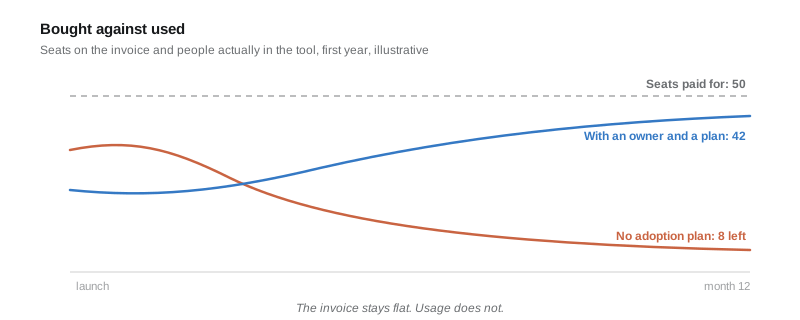
The invoice stays flat. Usage does not.
The old way wins by default, because the old way has a superpower: everyone already knows it. A new tool has to be adopted against the constant, gentle pull of habit, and the enthusiasm from the kickoff meeting is worth about two weeks of that fight.
After watching many tools survive and many die, I trust four predictors more than any feature list.
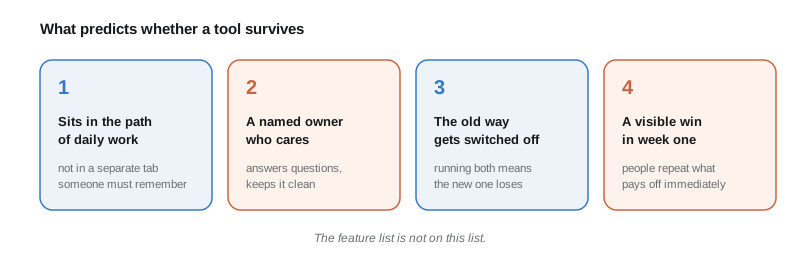
Four things that decide adoption. The feature list is not one of them.
First, the tool sits in the path of work that already happens. If using it requires remembering to use it, it is already dead. The order should arrive in it, the ticket should open in it, the report should come out of it. Tools survive when skipping them is more effort than using them.
Second, it has an owner. Not a sponsor who approved the invoice. A person who answers questions in the first weeks, cleans up the mess early users make, and cares visibly whether the thing lives. Software with an owner gets a second chance after a bad week. Software without one does not.
Third, the old way gets switched off. This is the step everyone skips because it feels harsh. But as long as the old spreadsheet still circulates by email, every stressed person will use it, and the new tool slowly becomes the optional extra. Running both is not a transition. It is a decision for the old way, made politely.
Fourth, there is a visible win in week one. Something concrete a user gets out of the tool in the first days: a report that used to take an hour, a search that used to mean asking three people. People repeat what pays off immediately and abandon what promises to pay off eventually.
Notice what is not on the list. Training sessions help, but they do not decide anything; people forget training and remember habits. Features matter even less. The tools that survive in the companies we work with are rarely the most powerful ones. They are the ones that fit.
If you are buying software this quarter, budget adoption like a project of its own. A workable rule of thumb: plan as much internal effort for the first three months as the first year of licences costs. That effort buys the owner's time, the workflow changes, the data migration, and the week-one wins. If that sounds expensive, compare it with the licence that renews for years while eight people out of fifty log in.
Then measure the only number that matters: weekly active users against seats paid. Put it in the renewal calendar. If fewer than half the seats are alive after six months, either relaunch the tool properly or cancel it. Both are respectable decisions. Renewing on autopilot is not one.
One client of ours audited their subscriptions last year and found eleven tools. They cancelled seven, kept three, and relaunched one, the support desk, with an owner, a switched-off inbox, and a two-week win. The savings paid for the relaunch several times over, and the support desk is now the one tool everyone actually opens.
Software you pay for is a cost. Software your people use is an asset. The distance between the two is not in the product. It is in the three months after the invoice, and whether anyone owns them.
Questions I hear about software adoption
Why do employees stop using new software?
Because the old way is faster under pressure and nobody switched it off. Habit pulls people back within two or three weeks, especially when the new tool lives outside their daily workflow and no owner is there to answer questions and clear early friction.
How do you measure software adoption?
Weekly active users against seats paid is the honest core metric. Add one usage signal that matters for the tool, like tickets handled in it or documents created in it, and check whether the old way still circulates. Review the numbers before every renewal, not after.
How much should a company budget for adoption?
Roughly as much internal effort in the first three months as the first year of licences costs. That covers an owner's time, workflow changes, data migration, and producing visible wins in the first weeks. Skipping this budget is how shelfware gets made.
Should we cancel tools nobody uses?
Yes, at the next renewal, unless you are willing to relaunch them properly with an owner, a switched-off old way, and a week-one win. Cancelling and relaunching are both respectable decisions. Renewing out of embarrassment is the only wrong one.